Funded Projects
Observatoire des Sciences de l’Univers OREME
PI: Anne Charmantier & Claire Doutrelant
Dates: annual long-term funding since 2009
The long term Observation Platform OSU-OREME has been the only perennial support our project has had, with funding for our field observations since 2009. Check out our Tit Observation Task (TO = tache d’observation) here https://oreme.org/observation/ecopop/mesanges/
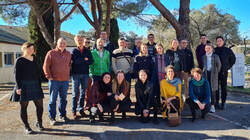
Kick off meeting for project ACACIA in Montpellier – 13/01/2023
ANR project ACACIA
PI : Anne Charmantier (CEFE, Montpellier)
Main collaborators : Samuel Caro, Sarah Cubaynes, Claire Doutrelant, Céline Teplitsky & Arnaud Grégoire (CEFE), Aurélie Zwang (LIRDEF), Baptiste Chenet & Marc Romans (Parc du Lunaret), Clotilde Biard (iEES), Philipp Heeb (EDB)
Dates: 2023-2027
Title: Adapting to Cities And Climate change In interAction
Abstract (click to read)
In the field of Evolutionary Ecology, climate change and urbanisation have been typically studied separately. However, urban heat island effects in cities represent a major challenge for urban dwellers facing climate change, particularly during extreme climatic events such as heat waves. The urban heat effect therefore constitutes a unique opportunity for understanding how organisms can adapt to global warming. Project ACACIA aims at 1. understanding and predicting the impact of the dual and interactive effects of climate change and urbanization using a model species in wild evolution and ecology: the great tit, and 2. using the example of great tits facing climate change as an educational tool to reconnect urban school-children to nature. We will address three tasks, based on a/ experimental data from a common garden across three forest/urban pairs in France, b/ longitudinal data on 13 forest/urban great tit monitorings across Europe, and c/ a participatory research protocol in 14 schools (minimum) of Montpellier and Paris associated with an educational device. In task 1, ACACIA will build a fine-scale map of temperatures across urbanisation gradients, provide insight into physiological adaptations (from phenotypes to genes) to warming, in forest versus city birds, and test the hypothesis that city-dwelling organisms may be pre-adapted to a warming climate because they are exposed to the urban heat island effect. In task 2, the wide European collaboration across great tit monitorings, will allow testing whether phenological adjustments to temperatures are similar across forest/urban populations, and assessing the associated evolutionary and demographic consequences of this plasticity. In task 3, we will involve schools in the collection of scientific data while providing education on science and the environment, and documenting effects to the participative device on children’s connection to nature. The three interdisciplinary tasks will produce major advances in our understanding of how the city environment may shape bird adaptation to climate change and how environmental education sciences on this topic from a young age can contribute to reconnecting humans with nature.